TLDR
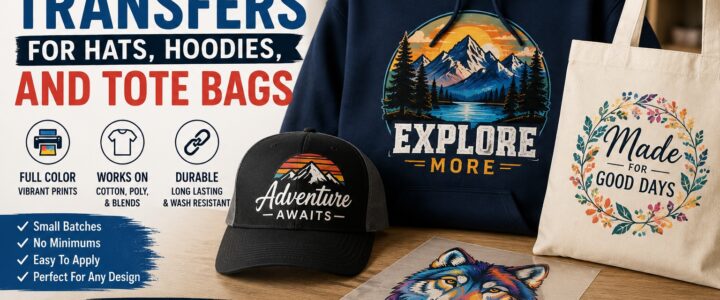
DTF transfers for hats, hoodies, and tote bags are a practical way to make custom merch without ordering huge screen-printed runs.
They work well for full-color designs, small batches, brand logos, event merch, team apparel, and product launches. Hoodies and cotton tote bags are usually easier to press than hats because they have flatter surfaces. Hats can still work well, but they often need a cap press, curved platen, and smaller artwork.
For most small brands, DTF transfers are best when you want flexible quantities, detailed artwork, and a finished look without buying professional printing equipment.
DTF Transfers Make Custom Merch Easier To Start
DTF transfers for hats, hoodies, and tote bags solve a common small-business problem: you want custom apparel and accessories, but you do not want to commit to a huge order before you know what will sell.
That is where direct-to-film transfers make sense. A DTF transfer is a printed design made on a special film, backed with adhesive, and applied to fabric with heat and pressure. Instead of printing directly onto the item, you press the finished transfer onto the garment or bag.
This makes DTF useful for:
- Small merch drops
- Staff apparel
- School spirit wear
- Team hoodies
- Event tote bags
- Brand hats
- Creator merch
- Local business uniforms
- Market booth products
- Limited seasonal designs
The appeal is simple. You can test designs in smaller quantities, use full-color artwork, and decorate different products without setting up screens for every color.
Screen printing still makes sense for large runs of simple designs. Embroidery still looks great on many hats. But DTF transfers sit in a useful middle: detailed artwork, flexible quantities, and a clean finish when pressed correctly.
Why Use DTF Transfers For Hats, Hoodies, And Tote Bags?
Hats, hoodies, and tote bags are three of the most useful merch items because people actually use them.
A shirt might get worn once in a while. A hoodie can become part of someone’s regular rotation. A tote bag can carry groceries, books, market goods, or event materials. A hat can put your logo in front of people all day.
DTF transfers work well across these items because they can handle:
- Full-color logos
- Gradients
- Small details
- Illustrations
- Mascots
- Slogans
- Event artwork
- Limited-edition designs
- Light or dark fabric colors
That flexibility matters for small brands. You can make a hoodie with a large back print, a tote with a bold front design, and a hat with a smaller logo using the same general artwork system.
A supplier like CustomStickers.com is useful here because you can order custom DTF transfers that are ready to press. You upload the artwork, choose the size, and use the transfers on compatible garments or fabric products.
That is much simpler than buying a DTF printer, ink, film, powder, curing equipment, and a full production setup.
DTF Transfers For Hoodies
Hoodies are one of the best products for DTF transfers because they have enough surface area for strong designs. A hoodie can hold a small left-chest logo, a sleeve detail, a large back print, or a full front graphic.
Good hoodie placements include:
- Left chest logo
- Center chest design
- Large back print
- Sleeve print
- Small cuff detail
- Hood print, when the shape allows it
- Inside neck label, if using a small transfer
Hoodies do come with a few pressing challenges. The fabric is thicker than a T-shirt. Seams, pockets, drawstrings, and zippers can create uneven pressure. Uneven pressure is one of the main reasons transfers fail.
For best results, keep the print area flat. Move bulky seams off the press when possible. Use a heat press pillow or pressing pad when needed to raise the print area above seams and pockets.
For pullover hoodies, avoid placing a transfer too close to the front pouch pocket. That area can be hard to press evenly. For zip hoodies, avoid trying to press across the zipper. Split designs can work, but they require more care.
Best hoodie uses:
- Streetwear-style merch
- Team hoodies
- Employee apparel
- School spirit wear
- Band merch
- Creator merch
- Coffee shop or restaurant apparel
- Gym or fitness brand hoodies
Hoodies are also a good place to use larger designs, but be careful with big solid blocks of ink. DTF prints sit on top of the fabric, so a huge solid rectangle can feel heavier than a smaller, more open design.
DTF Transfers For Tote Bags
Tote bags are another strong fit for DTF transfers, especially cotton and canvas totes. They are flat, useful, and easy to brand.
Good tote bag placements include:
- Center front logo
- Large illustrated design
- Small lower-corner logo
- Event artwork
- Brand slogan
- Market booth graphic
- Gift shop design
- Sponsor or fundraiser logo
Totes are popular because they work for many groups:
- Boutiques
- Farmers markets
- Bookstores
- Coffee shops
- Bakeries
- Wedding welcome bags
- Conferences
- Nonprofits
- School events
- Artists and creators
Cotton and canvas totes are usually easier to press than hats because the surface is flat. The main thing is to pre-press the bag to remove moisture and wrinkles. A smooth surface helps the transfer bond better.
Also place a protective sheet or pressing pad inside the tote when needed. Some bags have seams, folds, or inner layers that can affect pressure. You do not want the two sides sticking together or pressure landing unevenly.
Non-woven polypropylene totes are trickier. These are the soft, reusable grocery-style bags that feel more like plastic fabric. They can be heat-sensitive, so they may need lower temperatures, shorter press times, and careful testing. Do not assume every tote bag material can take the same heat.
Best tote uses:
- Event swag bags
- Retail shopping bags
- Artist merch
- Branded gift bags
- Market bags
- Fundraiser bags
- Welcome bags
- Small business packaging
A tote bag is also a good first DTF product because the shape is forgiving. If the print area is flat and the fabric can handle the heat, the process is usually straightforward.
DTF Transfers For Hats
Hats can look great with DTF transfers, but they are less forgiving than hoodies or totes.
The challenge is the curve. A flat transfer has to bond to a curved surface. The front panel of the hat may also have seams, structure, foam, mesh, or uneven tension. If the transfer does not sit flush, corners can lift or the image can wrinkle.
For hats, smaller designs usually work best.
Good hat placements include:
- Front center logo
- Small side logo
- Back strap area, when flat enough
- Beanie front cuff
- Trucker hat front panel
- Simple patch-style artwork
Avoid large, detailed prints on curved hat panels unless you have the right press and experience. A small logo is much easier to apply cleanly than a wide graphic that wraps around the front of a cap.
For structured caps and trucker hats, a cap press with a curved platen is usually better than a flat heat press. It holds the hat shape and helps apply even pressure. Heat tape can help keep the transfer in place, but it should not wrinkle or pull the film out of alignment.
Beanies can also work, but knit fabric stretches. Use moderate pressure and avoid overstretching the surface before pressing. A design that looks straight on a stretched beanie may distort when the fabric relaxes.
Best hat uses:
- Small business logo caps
- Staff hats
- Trucker hats
- Beanies
- Event caps
- Creator merch
- Club hats
- Sports team fan gear
If hats are your main product, test a few blanks first. Different cap styles behave differently under heat.
Artwork Tips For Better DTF Results
Good DTF results start before the heat press. The artwork matters.
Use clean, high-resolution files. Avoid tiny text. Make sure the design has enough contrast against the garment color. If the design will go on black, navy, forest green, or another dark fabric, check that the colors still stand out.
Artwork tips:
- Use transparent backgrounds when the design should not have a box around it.
- Keep small text large enough to read from a few feet away.
- Avoid thin lines that may disappear on textured fabric.
- Size the design for the actual product, not just the screen.
- Use stronger contrast for dark garments.
- Test one item before pressing a full batch.
- Keep hat designs simpler than hoodie or tote designs.
- Leave room around seams, pockets, zippers, and handles.
A hoodie can handle more detail than a hat. A tote can handle a bold illustration. A cap usually needs a tighter logo or badge-style design.
Let the product shape guide the artwork.
How To Choose Sizes For Each Product
Sizing is one of the easiest places to make a mistake.
A design that looks normal on a hoodie may be huge on a hat. A logo that looks bold on a cap may look tiny on a tote.
Practical starting points:
- Hats: small logos, usually compact and centered
- Beanies: small to medium designs on the cuff
- Hoodies: left chest logos, center chest graphics, or large back prints
- Tote bags: medium to large centered designs
- Sleeve prints: narrow vertical or horizontal artwork
- Inside neck labels: very small transfers
Before ordering, print the design on paper at the intended size. Cut it out and place it on the blank product. This low-tech test works. It shows whether the design feels balanced before you spend money.
For a merch drop, create a consistent system. For example:
- Small logo for hats
- Medium logo for hoodie chest
- Large design for hoodie back
- Medium-large design for tote bags
That gives the line a connected look without forcing the same exact size onto every item.
Pressing Tips That Prevent Problems
Every transfer supplier should provide application instructions. Follow those first.
Still, a few general rules help:
- Pre-press the item to remove moisture and wrinkles.
- Use even pressure.
- Keep seams and zippers away from the press area.
- Use a pressing pillow when needed.
- Let the transfer peel according to the supplier’s instructions.
- Do a second press if recommended.
- Test before production.
- Adjust settings for heat-sensitive fabrics.
Cotton can usually handle more heat than polyester. Polyester and performance fabrics can be more sensitive to scorching, shine marks, and dye migration. Totes made from synthetic materials can be even more sensitive.
Hoodies need attention because the fabric is thick. Hats need attention because the surface is curved. Totes need attention because the material can vary.
The process is not hard, but it does reward patience.
Washing And Care
Care instructions help customers keep the print looking good.
For DTF-decorated apparel, a simple care card can say:
- Wait 24 hours before the first wash.
- Wash inside out.
- Use cold water.
- Use mild detergent.
- Avoid bleach.
- Avoid fabric softener.
- Tumble dry low or air dry.
- Do not iron directly on the print.
For tote bags, care depends on the material. Cotton totes may be washable, while some non-woven bags should be spot-cleaned instead. For hats, spot cleaning is often safer than machine washing, especially for structured caps.
Small brands should include care instructions with hoodie and tote orders. It reduces avoidable damage and makes the product feel more complete.
When DTF Transfers Are The Right Choice
DTF transfers are a good choice when you want:
- Full-color artwork
- Small or medium batches
- Multiple product types
- Dark garments
- Detailed designs
- Fast merch testing
- Lower setup commitment
- Flexible product launches
They may not be the best choice when:
- You need thousands of the same simple design
- You want embroidery texture on hats
- You need an ultra-soft print on a large solid area
- The product cannot handle heat
- The design has very tiny text
- You do not have a reliable heat press setup
For many small brands, DTF is a strong first step. You can test demand, build a merch line, and learn what customers actually buy before committing to larger production methods.
A Simple Starter Plan
Start with three products:
- A hoodie with a left chest logo and optional back print.
- A cotton tote bag with a centered front design.
- A cap or beanie with a small logo.
Use one design family across all three. Do not make every item completely different at first. Keep the colors, logo, and style consistent.
Order a small transfer batch, press samples, take product photos, and test sales. If the hoodie sells but the hat does not, you learned something. If the tote gets the most interest, order more. That is the advantage of DTF transfers: you can adjust without being stuck with a huge inventory mistake.
Final Thoughts
DTF transfers for hats, hoodies, and tote bags give small brands a practical way to make custom merch without overcommitting. Hoodies give you room for bold designs. Tote bags are useful, flat, and easy to brand. Hats are great for logos, but they need more careful pressing because of the curve.
The best results come from matching the design to the product. Use simple, compact artwork for hats. Use stronger graphics for hoodies and totes. Test blank materials before making a full batch. Follow the transfer supplier’s pressing instructions.
For creators, restaurants, boutiques, teams, schools, and local brands, DTF transfers can make merch feel much more accessible. You can start small, learn what sells, and grow the line from there.
And for ready-to-press transfers, CustomStickers.com offers a straightforward way to order custom DTF transfers without buying the full printing setup yourself.